Half-lap joints in a timber frame veranda
In a half-lap joint, two beams are each cut to half their depth where they cross, so they sit flush in one plane. In our verandas we use half-laps where beams cross or continue in line, for example at the corners of the wall plate.
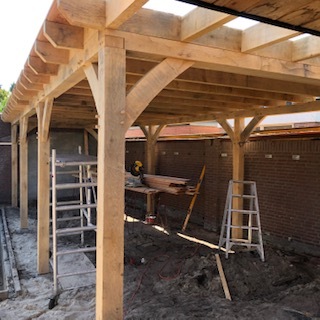
How strong is it?
On its own a half-lap is weaker than a mortise and tenon, because each beam loses half its depth at the joint. That is why we peg it and combine it with braces and mortise and tenon joints. With posts of 15 x 15 or 18 x 18 cm there is plenty of timber left after the cut.
Half-laps in Douglas fir
Douglas fir is softer than oak and easy to work, but less durable at class 3 to 4, so an oil that keeps water out of the joint matters. See treating Douglas fir.
Where we use them
- At the corners of the wall plate.
- To lengthen long beams.
- Where rafters cross a beam.
Where a beam must not pull out, we use a dovetail instead.
Get a price
The calculator gives you an instant price for our standard models. Treat those models as a starting point: every project is made to the customer's own specification, in any size you want. Need a size or layout the calculator does not offer? Send us your sketch through the contact page or on WhatsApp.
Frequently asked questions
Do I have to cut the half-laps?
No, every joint is cut and the frame goes together from the drawing.
Are half-laps screwed?
In the frame we use oak pegs. Only rafters and roof boarding are screwed.
More about timber verandas
- Wooden verandas made to measure
- Oak framed veranda
- Douglas fir veranda
- Timber frame veranda kits
- Modern black veranda
- Luxury garden canopies
- Modern veranda
- Pool house
- Build a wooden shelter
- Building a shed
- Self-assembly guide
- Timber frame joints
- What does it cost?
- Planning permission
- Lifespan and maintenance
- Oak frame kits
- Oak garden buildings
- Luxury garden room
- Garden room with veranda
- Mortise and tenon
- Oak or Douglas fir
- Installing a veranda
- Projects with photos
- Price your veranda