Douglas Fir Framed Buildings | Warm, Bespoke Craftsmanship
Our Douglas fir framed buildings are pure craftsmanship: solid softwood, joined with mortise and tenon and half-lap joints — with not a single visible screw. The signature curved braces and warm, honey-toned finish give every design its own distinctive, luxury silhouette. Fully bespoke to your garden, at excellent value for money.
Deliverytime UK
7 to 14 days delivery time
For Fence and Decking
Free delivery from £4300
Up to £4300 delivery charge £250
Parcel service (small box) delivery £26
- Free delivery from £4.300
- Delivery in 14 days
- Up to £4.300 delivery charge of £250
Ipe packages
Large timber bundles
Delivery time 6-8 weeks
Delivered in 15 days
Package L
From £ 4.300 free deliveryPackage XL
From £ 4300,- free delivery7 to 14 days delivery time
Package L
From £ 4300 free deliveryPackage XL
From £ 4300,- free delivery7 to 14 days delivery time
Package L
From £ 4300 free deliveryPackage XL
From £ 4300,- free delivery15 days delivery time
Package L
Delivery price on requestPackage XL
Delivery price on requestCanopies · Douglas fir · Handcrafted, made to measure
A Douglas fir framed building from Hardwood Discount pairs a warm, natural look with traditional mortise and tenon and half-lap joints. This tough softwood is lighter than oak and offers excellent value for money, without cutting any corners on craftsmanship. Fully bespoke to your garden, supplied as a numbered kit.
 A Douglas fir framed canopy as a natural extension of the house: warm in colour and fully made to measure.
Two joinery techniques, the same precision
With Douglas fir too, the craftsmanship is in the joint, not a screw. Every part is first cut to the millimetre in our own workshop, then hand-assembled.
Mortise and tenon
A projecting tenon fits precisely into a matching mortise cut into the connecting beam. A centuries-old, storm-proof technique with no visible fixings.
Half-lap joint
Each beam is cut away by half its thickness so the two halves sit flush at the crossing point. On Douglas fir this gives a crisp, distinctive line at every joint in the frame.
Both joints are machine-cut to measure, so the whole structure is guaranteed to fit together like a puzzle. And just as with our oak buildings, assembling the frame — posts, roof beams and braces — uses not a single screw: everything is held together with timber pegs or, on heavier structures, concealed steel fixings that stay completely out of sight.

Curved braces and the warmth of softwood
Just as on our oak framed buildings, the thick braces are deliberately given a slight curve rather than cut straight, adding lateral strength and a distinctive silhouette. The difference is in the timber itself: Douglas fir is a tough softwood with a warm, honey tone and a characterful grain — lighter than oak, and just as at home in a country garden as in a modern one.
Left untreated, Douglas fir develops a natural silver-grey patina over time. If you'd rather keep that warm honey tone, an occasional coat of UV-resistant timber oil will do the job.
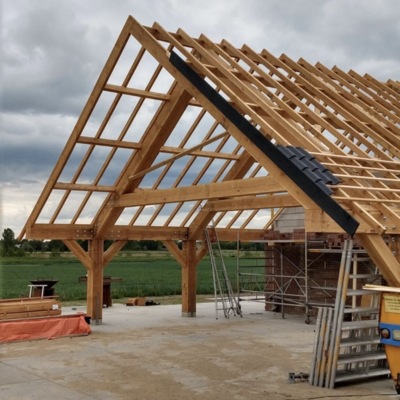 The warm colour of Douglas fir suits a country setting naturally.
Fully bespoke, from sketch to kit
- Send us a sketch of your Douglas fir canopy, veranda or garden room, with the dimensions you need.
- We'll price it up free of charge and put together a bespoke quote, or use our online calculator directly.
- Once approved, you'll receive a clear, numbered construction drawing with every measurement of your structure.
- Every Douglas fir component is then cut to size in our workshop and numbered in sequence.
- You receive a ready-to-assemble kit that, thanks to the numbering, is guaranteed to fit together like a puzzle — delivery in around 8 weeks after approval.
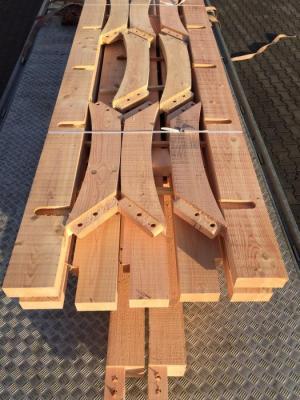
Because every project is made to measure, these Douglas fir bespoke structures are priced on request. Request a free, no-obligation quote, tailored to your garden's dimensions and layout.
Walls, sliding screens and natural light
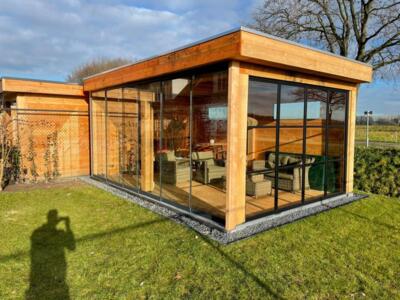
Add the right walls and your Douglas fir canopy becomes a proper garden room. Choose natural Douglas fir cladding for a look that flows seamlessly from the frame, or go for modern black-coated timber for a crisp, contemporary contrast against the warm wood. The roof comes with tongue and groove boarding as standard, and an integrated rooflight brings in plenty of natural light without losing heat. Where you'd like to close the structure off completely, our steel doors give a sleek, secure finish that suits both a traditional and a modern build.
Douglas fir or oak?
Douglas fir is the warmer, lighter choice: a tough softwood with an attractive price point, ideal if what you're really after is character and a bespoke build at a more accessible investment. Solid oak is heavier and more exclusive, developing a distinctive silver-grey patina over the years that gives it an even more rugged, premium feel. Both timbers are joined by hand at our workshop with no visible screws — the real difference comes down to weight, price and how each timber weathers over time. Still deciding? Take a look at our oak framed buildings for comparison.
"The decking and the complete veranda were delivered quickly within 8 weeks. All parts of the veranda were numbered and a manual and construction drawing were included. With a few men we assembled all beams in an afternoon. The EPDM roofing was already on at the end of the afternoon. On the second day we installed the fascias and laid the hardwood decking. The second evening we used the veranda for a barbecue with friends. I would definitely recommend this company."
More reviews with photos are on our inspiration page.
Frequently asked questions about bespoke Douglas fir buildings
Why is Douglas fir cheaper than oak?
Douglas fir is a softwood that grows faster and in greater volume than oak, which keeps the raw timber cost lower. It's also lighter, which makes it quicker to work with. Together, that makes Douglas fir excellent value without compromising on the joinery itself.
Is Douglas fir suitable for outdoor use?
Yes. Douglas fir is known for good natural durability and hardness for a softwood, and has been used for verandas, canopies and garden buildings for decades. Sited correctly - clear of the ground and with good ventilation - a Douglas fir structure will last for decades.
Does Douglas fir weather grey like oak?
Left untreated, Douglas fir does develop a natural silver-grey patina, much like oak. If you'd prefer to keep the warm, honey tone, treat it periodically with a UV-resistant timber oil.
What joints are used on a Douglas fir structure?
We use traditional mortise and tenon and half-lap joints, the same techniques proven storm-proof and stable for centuries. Not a single screw is used when the frame itself is assembled.
How long does the bespoke process take?
Once you approve the construction drawing, production takes around 8 weeks. You'll then receive a ready-to-assemble, numbered kit.
Can I assemble the Douglas fir building myself?
Yes. Every part is numbered and supplied with a clear construction drawing, so the build is straightforward to follow. Douglas fir is also lighter than oak, which makes self-assembly that bit easier. We'd recommend building it with two or three people.
Can I choose between natural and black Douglas fir cladding?
Yes. Natural Douglas fir cladding keeps the warm, cohesive look of the main frame. Black-coated cladding, on the other hand, gives a sharp, modern contrast.
Do I need planning permission for a Douglas fir canopy?
That depends on the size, position and your local planning rules. Always check with your local planning authority beforehand, as requirements vary by area.