Treating Douglas fir outdoors
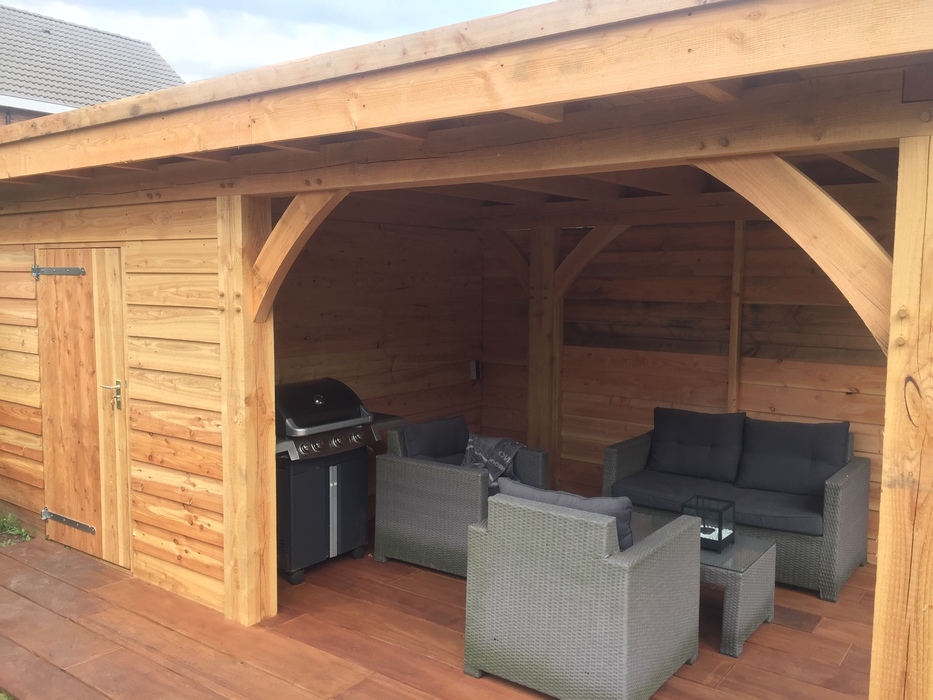
The best treatment for a Douglas fir veranda is oil, soon after assembly and then about once a year. Douglas fir is a softwood with durability class 3 to 4, less durable than oak. Oil keeps water out, the timber stays more stable and keeps its warm colour for longer.
What to look out for
- End grain and the tops of beams first.
- No ground contact: posts sit on a pad, about 15 cm above ground.
- Resin: Douglas fir can bleed resin. Let drops harden, scrape them off, then oil.
- Fixings: Douglas fir is slightly acidic, so use stainless screws.
Oil or stain
Oil soaks in and is easy to touch up. A stain forms a film that can peel after a few years. For a veranda we recommend oil.
Black Douglas fir
On the modern black veranda the Douglas fir is black coated. Check every year that the coating is intact, especially on end grain.
For oak, see treating oak outdoors. Choosing a timber: oak or Douglas fir.
Get a price
The calculator gives you an instant price for our standard models. Treat those models as a starting point: every project is made to the customer's own specification, in any size you want. Need a size or layout the calculator does not offer? Send us your sketch through the contact page or on WhatsApp.
Frequently asked questions
What if I do not treat it?
It goes grey and dries out faster, with more splitting. Under a roof that matters less, but oil extends its life.
How often should I oil?
Usually once a year, or when it looks dull and dry.
More about timber verandas
- Wooden verandas made to measure
- Oak framed veranda
- Douglas fir veranda
- Timber frame veranda kits
- Modern black veranda
- Luxury garden canopies
- Modern veranda
- Pool house
- Build a wooden shelter
- Building a shed
- Self-assembly guide
- Timber frame joints
- What does it cost?
- Planning permission
- Lifespan and maintenance
- Oak frame kits
- Oak garden buildings
- Luxury garden room
- Garden room with veranda
- Mortise and tenon
- Oak or Douglas fir
- Installing a veranda
- Projects with photos
- Price your veranda