
Short decking boards of 120 and 150 cm: why use them?
Why short boards stay straighter
A long board of around 4 metres often has a slight bow or twist. When you lay it, you have to pull it straight against the previous board with a clamp or a wedge before fixing it down. That takes time and effort, and the result is not always tidy. With a 120 or 150 cm board the problem does not arise. Over that length Ipe stays straight, so the board sits right first time.
How the boards join end to end
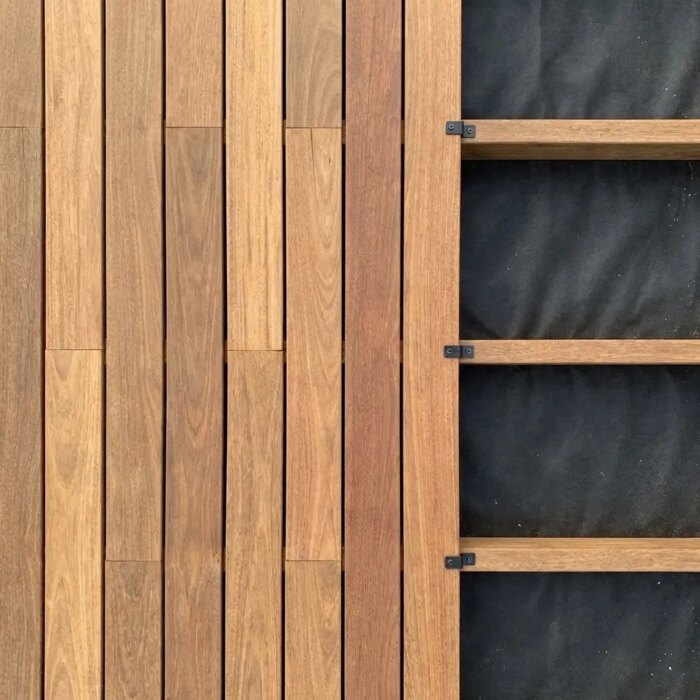
Every board has a tongue and groove on its ends. You slide the next board in lengthways and the two read as one continuous line, so you do not need to land every end joint on a joist. Along each long edge there is a groove for a black coated stainless steel clip. The clip is screwed to the joist and sets the 8 mm gap for you, with no screw heads on the surface. There is more on that gap in gap between decking boards.

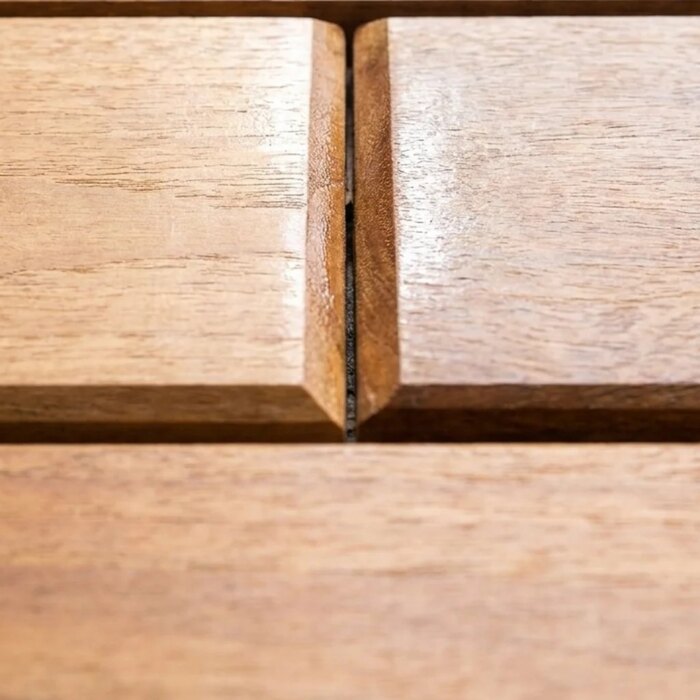
The double V at every end joint
Each board end has a bevelled edge. Where two boards meet, that gives a neat double V across the width of the board. The long edges do not have it; there you simply see the gap. It is a crisp detail you cannot get with boards butted together the old way.

The honest downside
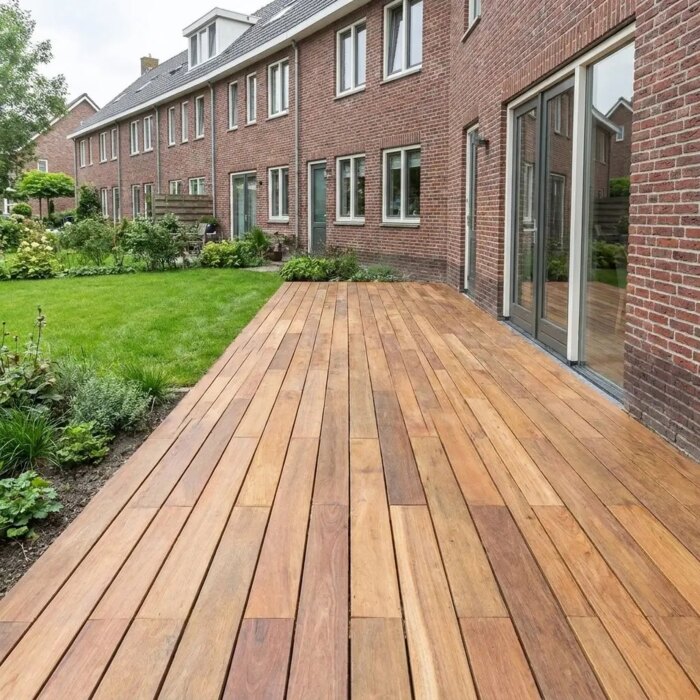
Short boards mean more end joints than 4 metre boards. You will see them, because they are part of the pattern. Stagger the joints across the deck and it looks calm, with no straight line running across your garden. If you would rather see hardly any joints, long boards are the answer, but bear in mind they often have to be pulled straight as you go.
What stays the same
- Board size: 21 x 140 mm, Ipe.
- Gap between boards: 8 mm, set by the clip.
- Joists: 40 to 45 cm apart, ideally Ipe, so you are not mixing timbers that work differently.
- Under the joists: weed membrane.
- Lifespan: 25+ years, even without maintenance. Oil is an optional extra for a dirt repellent, more stable surface.
Frequently asked questions
Does every end joint need to land on a joist?
No. The tongue and groove on the board ends lets the boards click together lengthways, even between two joists. Do make sure every board is fixed to at least two or three joists, and stagger the joints.
Can I build a large deck with short boards?
Yes. You make up the length of the deck with several boards end to end. However big the deck, the joists go 40 to 45 cm apart.
Take a look at our Ipe decking, or use the decking calculator to work out how many boards, joists and clips you need.
Tags for this article: