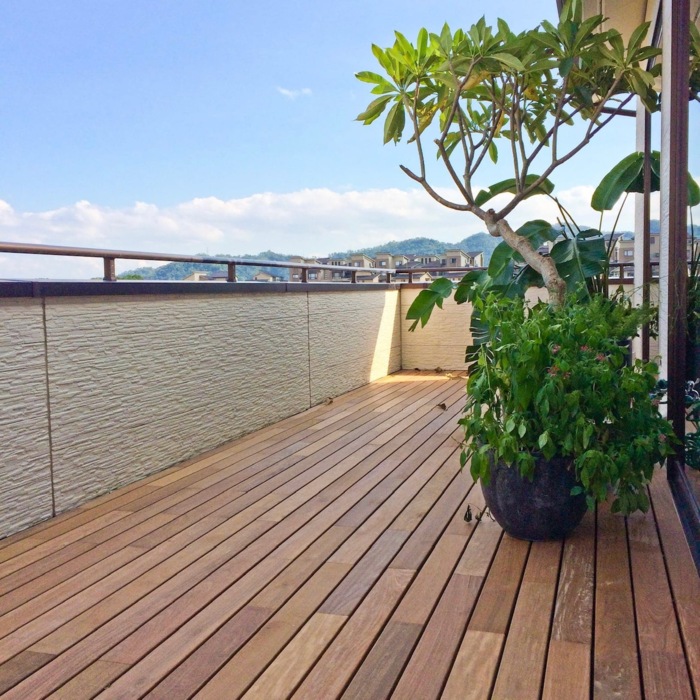
Best Wood for Decking: 6 Timbers Compared
In short: the best wood for decking is durable and stays dimensionally stable in thin boards. Ipe does best on both: durability class 1 and the lowest shrinkage of the common outdoor timbers, so the boards stay flat. Yellow balau and oak are class 2 and move more. Douglas fir and larch are softwoods of class 3 to 4 and have a shorter life. Ekki is durable but not stable enough in thin boards.
What makes good decking timber?
A deck board lies flat, gets wet on top and dries out again, which is hardest on thin, wide sections. Four things decide how well a board copes over the years:
- Durability class. How well the heartwood resists fungal decay. Class 1 is the highest, class 5 the lowest.
- Movement. How much the wood swells and shrinks with moisture. Low shrinkage means less cupping, warping and splitting.
- Hardness. Whether furniture legs and heels leave dents.
- Sapwood. Sapwood is not durable in any species. Good decking boards are free of it.
Decking timbers compared
| Timber | Durability class | Shrinkage across the width | Hardness (Janka) | Good for deck boards? |
|---|---|---|---|---|
| Ipe | 1 | 6.4% | 15,520 N | Yes, stable in thin boards |
| Yellow balau (bangkirai) | 2 | 9.5% | 7,120 N | Yes, but more prone to cupping |
| Ekki (azobe) | 1 to 2 | 10.3% | 14,330 N | Less so, thin sections are not very stable |
| European oak | 2 | 9.7% | 4,980 N | Moderate, moves a lot in thin boards |
| Douglas fir | 3 to 4 | 6.9% | 2,760 N | For a budget deck, shorter life |
| Larch | 3 to 4 | 8.2% | 3,290 N | For a budget deck, shorter life |
Sources: CIRAD Tropix (durability, tangential shrinkage at 12% moisture content) and The Wood Database (Janka).
Why we only supply Ipe for decking
Ipe is the only timber in this list that Tropix rates as stable. With 6.4% shrinkage across the width it moves less than yellow balau, ekki or oak, so our boards can stay slim at 21 x 140 mm without cupping. Ipe weighs around 1,050 kg per m³, is class 1 and lasts 25+ years as decking.
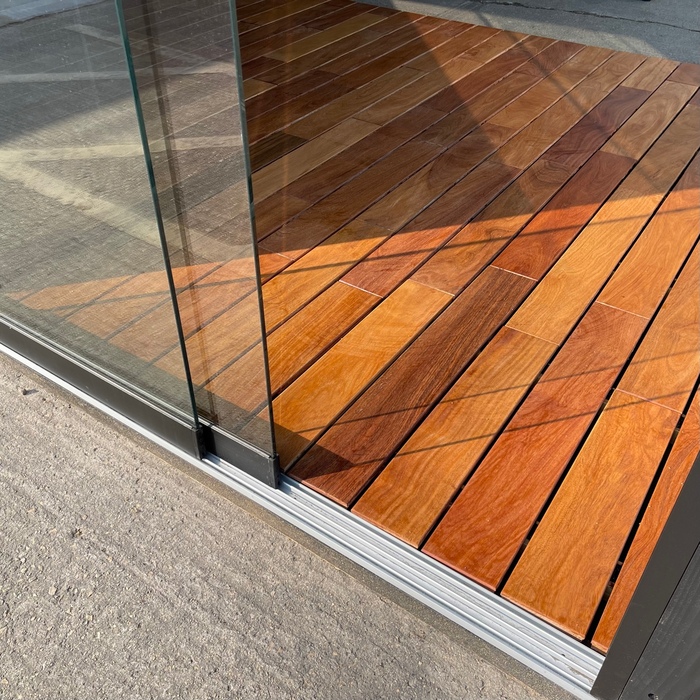
The boards come in short 1.2 and 1.5 m lengths, which are always dead straight. The ends have a tongue and groove so boards click together lengthways, with a chamfer that forms a double V at each joint. A black coated stainless steel clip slides into the side groove, leaving an 8 mm gap. The joists are Ipe too, so no two timbers work against each other.
How long does decking last?
Durability classes are measured on a post in the ground, the toughest situation. A deck sits above ground and can dry out, so it lasts longer than those figures. As a guide, Ipe lasts 25+ years as decking. Douglas fir and larch, class 3 to 4, manage 5 to 15 years in ground contact and need noticeably more care above ground too. The amount of sapwood makes a big difference.
What about massaranduba and cumaru?
Massaranduba and cumaru are heavy South American hardwoods also sold as decking. Tropix lists massaranduba as durability class 1. We do not supply either and have not tested them ourselves, so we make no claims here about movement or checking. If you are considering one, ask the supplier about the durability class, the grade and whether the boards are free of sapwood.
Timber or composite?
Composite is a blend of wood fibre and plastic. It brings different trade-offs from timber, such as how hot it gets in the sun and how it looks after some years. Weigh those up against the natural look and feel of a hardwood deck.
Decking timber questions
What is the best wood for decking in the UK?
A durability class 1 hardwood that moves little, such as Ipe. That combination keeps thin boards flat and long lasting in a wet climate.
Which decking lasts the longest?
Class 1 boards, free of sapwood and fitted with ventilation underneath. Ipe lasts 25+ years as decking.
Is softwood decking worth it?
For a budget deck, yes. Douglas fir and larch are class 3 to 4, so expect a shorter life and more maintenance than with a class 1 hardwood.
Is yellow balau a good choice?
It is class 2 and usable, but moves more than Ipe, so wide boards cup more easily. We no longer supply it.
Ready to choose? Browse our Ipe hardwood decking.
Tags for this article: