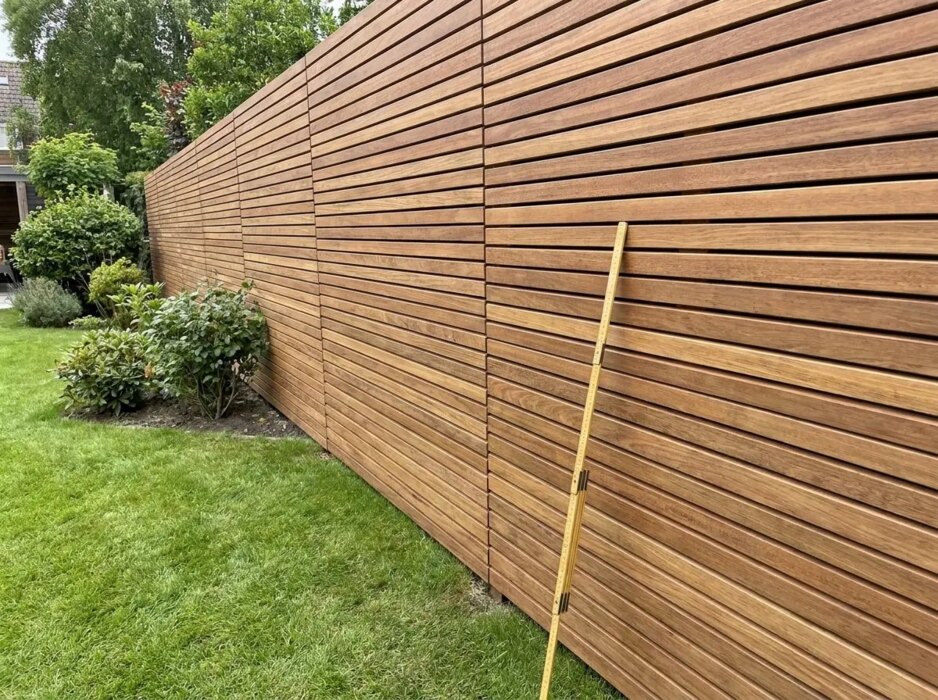

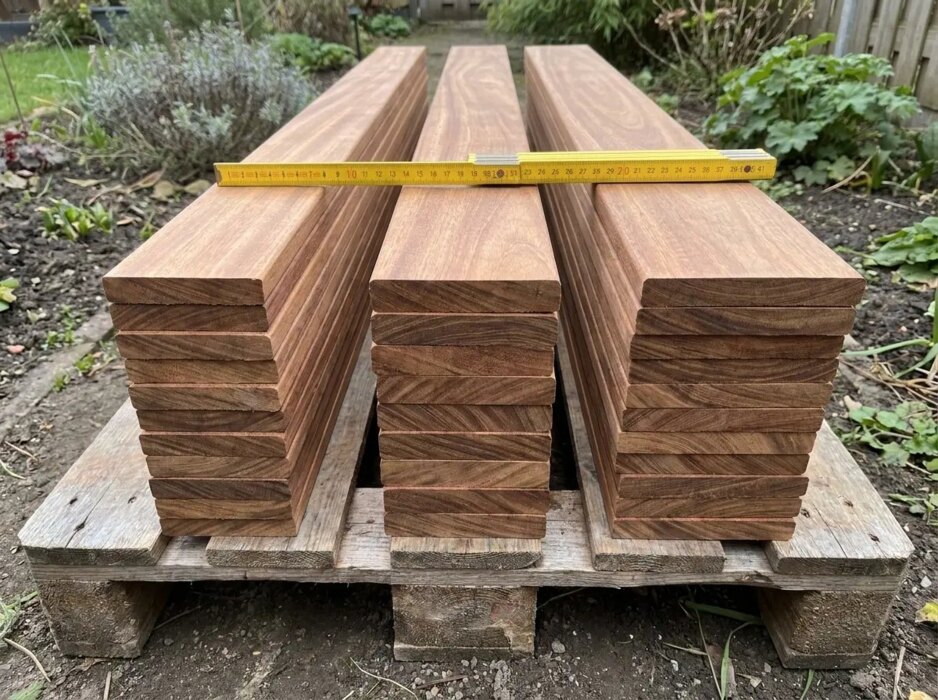
How many fence slats per metre do you need?
The sum in one line
In height, a slat takes up its own width plus the gap to the next slat. With our Ipe slats that gap is always 5 mm, because the clip doubles as the spacer. So divide the height of your fence by the slat width plus 5 mm.
| Slat | Per slat incl. gap | Slats per metre of height | Rows at 1.8 m |
|---|---|---|---|
| 50 mm | 55 mm | approx. 18 | approx. 33 |
| 70 mm | 75 mm | approx. 13 | approx. 24 |
| 90 mm | 95 mm | approx. 10.5 | approx. 19 |
Round the number of rows to a whole number. Your fence will end up a few millimetres taller or shorter than the round figure, which nobody will notice.
From rows to running metres
Once you know the number of rows, multiply it by the length of the fence. A fence 10 metres long and 1.8 m high in 70 mm slats needs about 24 rows of 10 metres, so 240 running metres of slat. If you want slats on both sides, double it.
Wastage stays low with our system. The slat ends have a tongue and groove, so you lay them in a staggered pattern and start the next row with the offcut from the last one.
Narrow or wide: what changes?
Narrow 50 mm slats give a fine, detailed look, but you need almost twice as many as with 90 mm slats. That means more clips and more fitting time. Wide 90 mm slats go up faster and give a calmer, bolder face. It comes down to the look you want and the hours you are happy to put in.

What else comes in the pack
- Ipe slats 21 mm thick, 50, 70 or 90 mm wide, fitted horizontally.
- Azobe (ekki) posts of 60 x 60 mm, set in the ground.
- Black coated stainless steel clips and screws, out of sight.
- Optional EPDM membrane behind the slats, for privacy and less noise.
Frequently asked questions
Does the same sum work for teak?
Yes. Our teak slats are 50 mm wide and use the same clip with the same 5 mm gap, so you also end up with about 18 slats per metre of height.
Why is the gap always 5 mm?
The clip doubles as the spacer, so the gap between slats is the same everywhere without measuring. On decking boards the gap is 8 mm.
Rather not do the maths? The fence calculator works out slats, posts and clips for you. Or browse our modern Ipe fencing.
Tags for this article: